
Regional Fragrance Preferences: A Buyer Checklist Before You Commit
Regional fragrance preference is real, but it is not the tidy stereotype that Europe wants heavy orientals and Asia wants light florals. What changes most reliably across markets is strength expectation, familiarity with a scent profile, and the associations that raw materials carry. All three can be tested before you commit to a bulk run. Treat preference as a hypothesis to check with noses in the target market, not as a rule to design around.
Key takeaways
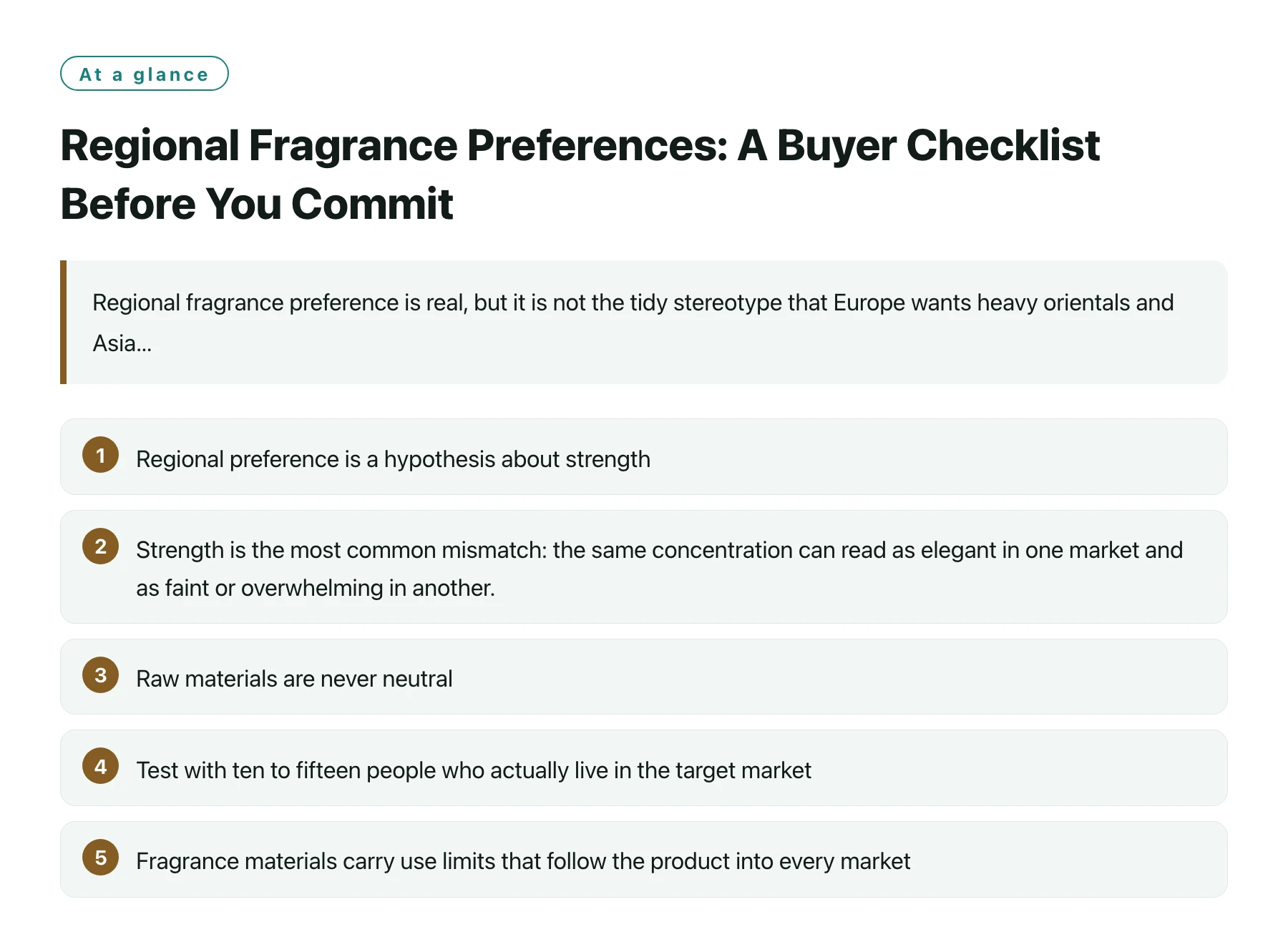
- Regional preference is a hypothesis about strength, familiarity and association, not a fixed national taste that applies to every buyer.
- Strength is the most common mismatch: the same concentration can read as elegant in one market and as faint or overwhelming in another.
- Raw materials are never neutral, so a note that signals luxury in one market can read as old-fashioned, medicinal or domestic in another.
- Test with ten to fifteen people who actually live in the target market, at the concentration and in the packaging you intend to sell.
- Fragrance materials carry use limits that follow the product into every market, so a formula that is fine at home may need reformulating for export [1].
Most launch plans treat the scent as a creative decision and the market as a distribution decision. In practice the two are entangled. The same formula can work in one country and sit on the shelf in another, not because the juice is worse but because it does not match what people there expect a perfume to smell like or to do.
That is why the useful question is not what people in a given market like, which invites stereotype, but what this specific formula will signal to someone who has smelled a thousand perfumes in that market.
The checklist below is the one worth running before a first production order. It assumes a creator or founder is launching a line and wants the scent to survive contact with the market rather than with a mood board.
What actually differs between markets
Three variables move the most, and they are worth separating because each one needs a different fix. The first is strength: how much projection and longevity a buyer expects at a given price. The second is familiarity: how close the scent sits to what already sells in that category. The third is association: what the raw materials themselves call to mind.
Strength expectations
Markets with a long tradition of lighter everyday wear tend to read a heavy composition as something for evenings or cold weather, while a market used to bold signature scents may read the same concentration as unfinished. Neither reading is wrong. It only means the dosage decision is a market decision as much as a perfumer's decision.
Familiarity and the novelty budget
Every launch buys a certain amount of novelty. Launch something entirely unfamiliar and you spend the whole marketing budget teaching people what they are smelling; launch something too familiar and there is no reason to switch. Creator-led brands usually have more room for novelty than they assume, because the audience already trusts the person recommending the scent.
What materials signal
Raw materials are never neutral. A white floral that reads as a classic in one market can read as dated in another, and a smoky or oud-forward accord that signals luxury to one audience can signal something else entirely to a second. A short conversation with someone who grew up in the market is worth more here than a trend report. Published category research is useful for spotting direction, not for predicting a single market's taste [2].
Turning a preference into something testable
A preference only becomes useful when it can be tested. That means fixing the variables that are not under test, meaning the concentration, the bottle and the price point, and changing one thing at a time. If the panel smells three versions at three strengths in three formats, the feedback will not tell you which change made the difference.
It also means recruiting the right panel. Colleagues in the same office are convenient and mostly useless for this question, because they share the same reference points. Ten to fifteen people who live in the target market and wear fragrance regularly will give a clearer signal than a much larger panel somewhere else.
Use the manufacturer's catalogue as a starting point
Before writing a brief, it is worth seeing what a manufacturer already makes and for whom. A company that publishes its categories and its markets gives you a faster starting point for the conversation, which is one reason to spend twenty minutes on a site such as https://www.xuelei.com before the first call rather than after the third sample. The question to bring to that call is not which scent is the bestseller, but which existing bases already sell to buyers in your market.
The pre-commitment checklist
- Fix the target market firstWrite down the country or region you are launching into, and the price tier, before any brief is drafted.
- State the strength expectation in wordsDescribe the effect you want, such as a close-wearing scent for daily use, rather than only naming a concentration.
- Smell the shelf you will sit onBuy the three or four products your buyer would compare you against, and smell them side by side on skin.
- Recruit an in-market panelTen to fifteen regular fragrance wearers who live in the market, smelling on skin, not on paper.
- Check the regulatory position earlyFragrance materials are restricted to safe use levels that travel with the product, so confirm the limits that apply to your market before the formula is frozen [1].
- Plan two iterationsBudget time for a second round of samples after the first panel, because the first round almost never settles the question.
One caution about panel feedback: people are good at telling you what a scent reminds them of and poor at telling you what will sell. Use the panel to find associations and mismatches, and use your own judgement, and your sales data later, to decide what to launch. A panel is a smoke detector, not a market forecast.
What to do with the answers
If the panel is consistent, the result is easy to use: adjust the dosage, adjust the brief, and move on. Inconsistency is the more common outcome, and it usually means the formula sits in an unfamiliar space for that market. That is not automatically a reason to change it. A creator-led brand can carry an unfamiliar scent if the story behind it is strong enough, but the decision should be deliberate rather than accidental.
The second output of the exercise is a document. By the end you should have a written statement of the market, the strength expectation, the reference products and the comments from the panel. That document is what a manufacturer actually needs, and it makes the difference between a supplier guessing and a supplier building to a specification. Buyers who work with Chinese houses often find that the quality of that brief, rather than the factory's location, decides how quickly the project moves what the global market wants from Chinese perfume.
Keep the version history
If you do reformulate for a second market, keep the versions distinct and labelled. Brands that end up with two or three market-specific variants and no record of which one is which create avoidable confusion in production, and the confusion usually surfaces as a defect claim rather than as a paperwork problem.
Sources
- IFRA Standards Library (International Fragrance Association) —— The IFRA Standards Library lists the restrictions the fragrance industry applies to individual fragrance ingredients, based on safety assessments; it is the reference point for compliant fragrance formulation.
- Mintel Press Centre —— Mintel's press releases on consumer and beauty market research, including fragrance and personal care trend reporting.
Frequently asked questions
Do regional fragrance preferences really exist, or is this a stereotype?
Both. Broad generalisations about national taste are unreliable and often dated, because cities within one country differ as much as countries do. What is reliable is that strength expectations, familiar scent profiles and the associations attached to specific materials vary by market, and those are the parts worth testing.
How large should a market test panel be?
Small and well chosen beats large and convenient. Ten to fifteen people who live in the target market and wear fragrance regularly will surface the obvious mismatches. Anything beyond that is better spent on a proper consumer test run by a research firm.
Should I create a different formula for every market?
Usually not. Most brands keep one core formula and adjust dosage or a single prominent accord. Separate formulas multiply inventory and complicate production, so it is worth doing only when the mismatch is fundamental rather than a matter of taste.
How early should compliance work start?
Before the formula is frozen. Material restrictions and labelling requirements differ by market, and finding out that a key ingredient is limited in your main market after the bulk batch is compounded turns a formulation issue into a production problem.
Can a brand with a global audience skip regional testing?
It can skip testing for a specific market, but not the reasoning. If the audience is genuinely spread across many countries, test against the two or three markets that carry most of the revenue, and accept that the scent will land differently everywhere else.